




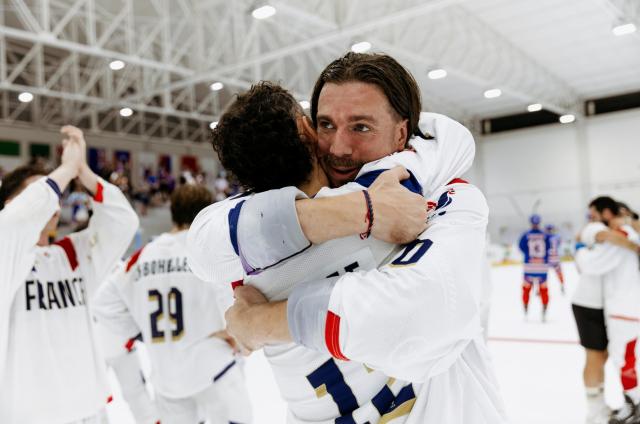
A new spring day opens over Paraguay as the participants, fans and World Skate Family wake after the celebration of one of the greatest inline championships ever held, and among the celebrating teams waking up, are two as new World Champions.
After more than two weeks of gruelling competition, Inline Hockey at the World Skate Games 2026 have reached conclusion. The final days delivered everything that makes inline hockey such a compelling spectacle: spectacular goals, relentless pace, tactical battles, extraordinary goalkeeping, and crowds whose passion threatened to lift the roof from the arenas.
France reclaimed the Senior Men's crown with a breath taking performance against Czechia, while Spain demonstrated their class to take Junior Women's gold against the USA. There were celebrations, heartbreak, and the culmination of months of preparation from athletes, coaches, officials and organisers.
But the story of these Games extends beyond the medals. Across the tournament, the international inline hockey community has demonstrated its fortitude, its ambition and its determination to steward the game, and keep pushing the sport forward.
The final whistle has sounded. The champions have been crowned. And the thunder of the storms and the drums that gathered in Paraguay has left their mark.
Senior Men: France reclaim the crown
Gold: France, Silver: Czechia, Bronze: USA
The Senior Men's final was one of the most dynamic, end-to-end inline hockey matches imaginable at this level.
It had everything: physical commitment, spectacular pace, creative decision-making, and shots of such audacity that it seemed nobody had any business scoring from those positions. Two of the strongest teams in the world met on the biggest stage, and both delivered.
France made a bright start, but every time they took a step forward, Czechia found a way to respond. The goals came thick and fast, with the Czechs often answering within a minute. Neither side was prepared to give an inch, and the substantial crowd watched almost breathlessly as the game swung from end to end.
The difference was marginal. France were just a fraction more direct, finding ways through a Czech defence that struggled to contain one remarkable finish after another. They maintained their pace and pressure throughout, never quite allowing Czechia to regain control, even as the Czechs chased them all the way.
With time running out, Czechia turned to an empty net in one final attempt to find an equaliser. But the inevitable result came to pass: France held on to win 7–5, bringing the Senior Men's gold medal back to France after a long absence.
Karl Gabillet was a standout performer in a French team where every individual contributed, both on and off the puck, and a Czech team stacked with veteran players who still put on quite the show.
This was a final worthy of the occasion. Two of the best teams in the world, both playing at their best, delivering the match everyone had hoped to see.
A masterclass in pace, precision and attacking ambition.
Junior Women: Spain out pace the USA
Gold: Spain, Silver: USA, Bronze: Colombia
The Junior Women's final was another masterclass, although expressed in a very different way.
The USA arrived having dominated their semi-final against Argentina, using their physical strength, speed and relentless work rate to prevent their opponents from establishing any attacking rhythm. Spain, however, offered a different challenge.
The Americans were determined, hard-working, tough and direct. But wheel to wheel, the Spanish were consistently faster, cleaner and more efficient. They moved with confidence, executed their game plan with precision and took control of the contest from the outset.
Spain led from the front and never let go.
The USA threw everything they had into the contest, a testament to their character and competitiveness. But against Spain's class and pace, they could never quite establish a rhythm of their own.
The final score was Spain 4–0 USA.
Spain had delivered the test that the Americans had not yet faced in the tournament, and they rose to it with authority. Their gold medal was the reward for a technically accomplished campaign, capped by a performance that demonstrated just how much quality exists in the next generation of international inline hockey.
For the USA, silver is a significant achievement, even if the final result will leave them wondering what might have been.
Senior Men's bronze: the USA finish with a response
Bronze: USA 2–0 Slovakia
After their heart-breaking shootout defeat to France in the semi-final, the USA returned to the rink to face Slovakia for bronze.
It was a tough affair, with plenty on offer from both sides. Slovakia worked hard to dispossess the Americans and disrupt their rhythm, but the USA remained in control of the match.
Once again, they elected to dictate the pace and timing, grinding out a solid win rather than allowing the contest to become an uncontrolled exchange of attacks.
The shot ratio tells the story: 10–1 in favour of the USA.
That is a remarkable degree of control, even if the final score of 2–0 might suggest a closer contest. Slovakia's goalkeeper produced a strong performance to keep the score respectable, but the Americans' ability to manage the game and limit their opponents' opportunities proved decisive.
The USA leave Paraguay with bronze rather than the gold they had appeared destined to win. Their semi-final defeat will undoubtedly sting, but their response against Slovakia demonstrated their ability to regroup and finish the tournament with a medal.
Colombia announce themselves on the world stage
Junior Women's bronze: Colombia 5–0 Argentina
Colombia defeated Argentina 5–0 to take Junior Women's bronze, an outstanding result that deserves recognition.
Colombia have established themselves as a competitive presence on the world inline hockey scene, and this bronze medal provides further evidence of the progress they have made.
Their development is particularly encouraging for South American inline hockey. The tournament has shown that the region is not simply providing enthusiastic participation; its teams are increasingly capable of competing for meaningful results against established international opposition.
Colombia's bronze is a reward for that progress, and a result on which the programme can build.
The other placement matches
The final day also brought the remaining placement contests, determining the final positions across the Senior Men's and Junior Women's divisions.
In the Senior Men's competition, Italy defeated Russia 7–2 to take fifth place. Namibia beat Argentina 4–0 for seventh, while Colombia defeated Switzerland 4–2 to claim ninth. Germany beat Chinese Taipei 2–0 to take the Presidents Cup, Mexico defeated Ecuador 7–1, and Uruguay edged Paraguay 2–1. Chile also recorded an 18–2 victory over Paraguay in the placement programme.
In the Junior Women's competition, Italy defeated Brazil 4–2 to finish fifth.
These results round out a tournament in which the established powers demonstrated their strength, while emerging programmes gained valuable experience and, in several cases, made significant progress.
The people behind the tournament: recognition for the IHTC
A World Championship is about far more than the players on the rink. Behind every match sits an enormous amount of work: scheduling, officiating, technical management, communication with national federations, and the constant negotiation required to keep a major international event moving.
The International Hockey Technical Commission (IHTC) deserves particular recognition for its work throughout the Games.
Their responsibility was not simply to establish the competition and get the matches underway. It was to manage and monitor the tournament throughout, while responding to the demands of competitive and ambitious national federations, each looking for every possible advantage in their pursuit of a gold medal.
It is a demanding position to occupy. The technical commission must protect the integrity of the competition, support the officials, interpret the rules consistently and maintain working relationships with federations whose interests do not always align.
By the assessment of those closely involved, the IHTC handled that responsibility more than well. The referees delivered a sterling performance, and the tournament achieved what was described as the lowest complaint ratio of any World Championship.
That is a significant achievement in a competition where every decision can carry enormous consequences.
The 2026 Games also brought new rules into the sport. Introducing changes at a World Championship always carries risk, particularly when players, coaches and officials are adapting to new requirements under intense pressure. The initial overall assessment, however, has been positive.
That does not mean the work is finished. Rules and their implementation must continue to be assessed, discussed and refined. The IHTC's ongoing responsibility is to ensure that inline hockey continues to develop as a sport capable of competing for attention on the world's sporting stage.
Particular recognition is due to Ramin Atcheghichi, Eddy Rojas and Lucille Cotzee, whose work has contributed to the technical delivery of the competition.
And at the centre of the relationship between the sport, the national federations and World Skate has been Andrea Fonzari. Balancing those interests is no easy task, and he received strong commendation from across those groups.
It is a fine balance indeed, and few can think of a better example of finding and maintaining that balance than Andrea.
The athletes may receive the medals, but a successful championship depends on the people who make it possible. The IHTC, the referees and the wider technical team deserve to share in the achievement of these Games.
The drums fade, the boards come down, and the lights go off, but the story continues
The World Skate Games in Paraguay have given us new champions, a host of memorable matches and another chapter in the continuing development of international inline hockey.
France's Senior Men's gold came through pace, creativity and an attacking ambition that never quite relented. Spain's Junior Women's victory was built on technical quality, confidence and a speed that even the formidable Americans could not match. Last week’s results for Italy and Spain are still circulating in the warm afterglow of world class competition.
That is the nature of a World Championship. The final whistle marks the end of the competition, not the end of the work.
But the memories will remain as we plot our directions home, and begin, just a flicker of an idea, something learned this fortnight, a strategy for next year, next tournament, next championship. Already, the work has begun.
"Fue un verdadero placer compartir este tiempo contigo, guardo los mejores recuerdos en el corazón. Que Dios te bendiga y guíe siempre tu camino. ¡Ahata ajumi! (Me voy, pero he de volver) y, si Dios quiere, ¡jajotopata jey! (¡ya nos volveremos a encontrar!). Te voy a extrañar mucho, un abrazo fuerte."
Farewell Paraguay, you were wonderful hosts, and we will hope to see you again!